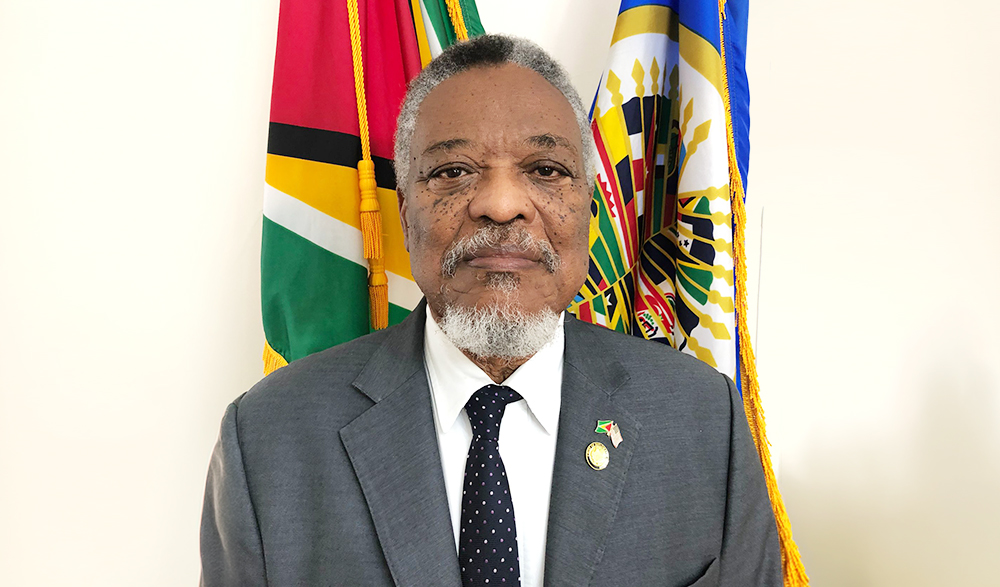
Jul 2026 Interview with H.E. Samuel A.A Hinds O.E., Ambassador of Guyana to the United States and Permanent Representative to the OAS
Aware of your background as a Prime Minister for two decades and a President for a brief period, how is Guyana balancing the rapid growth of its energy sector with the imperative to build a diversified, climate-resilient economy that ensures sustainable, long-term social development for all Guyanese citizens?
The rapid growth of our oil sector has enabled us to proceed more rapidly with the growth and development of our people and country, onwhich we had set out.
Guyana is, in many ways, a new country still in the making. Our ancestors came from six different peoples across four continents and with three religions. The overarching task, therefore, has always been to build “One People, One Guyana” out of such diverse origins. Our current President, H E Mohamed Irfaan Ali, regularly speaks about “One Guyana,” and that phrase reflects the ongoing national effort towards national unity.
Guyana was never a rich colony. It is geographically large, about 83,000 square miles, roughly the size of England, but its population is only now approaching one million people. At Independence (1966), about 90% of the population lived along a rudimentarily developed ten-mile-wide strip along 200 miles of its coast whilst about 10% of the population (mostly Indigenous peoples) lived in about 100 communities scattered across our hinterland. The plantation-owning families never really established permanent homes in Guyana. Most of the Europeans who livedthere were colonial public servants and hired managers. You do not see the grand estates or large family homes that exist in some other former colonies.
Despite the challenges, I believe Guyana has made more progress than many should have expected. I am not bewildered by the difficulties we have had since approaching Independence. In fact, I think that things could have been worse considering the circumstances.
Today, with the additional cash flow to our budget and growing job opportunities, we are moving forward rapidly. Ourpolitical tradition, beginning with the party of Dr. Cheddi Jagan, has always emphasized inclusion. Dr. Jagan himself was a first-generation Indo-Guyanese who came to Washington in 1936, at age eighteen, to study at Howard University, encouraged by an Afro-Guyanese friend. He dwelt here from 1936 to 1943. During that time, he married Janet Rosenberg, a white American woman of Jewish heritage. When he returned to Guyana, he began working withhis wife to deliberately bring our different peoples together – through the Political Affairs Committee (PAC), which he founded in 1946 and on which he launched the People’s Progressive Party (PPP) in 1950.
That tradition of inclusion continues today. Our aim has always been to work broadly across all sectors of Guyanese society. We have also focused on spreading government services and economic opportunities across the entire country. Healthcare is an illustration. Thirty years ago, you might have found a fully equipped hospital only in Georgetown. Today, every one of Guyana’s ten regions has a regional hospital with tertiary-level services, including some of the latest digital documentation, and supporting one another via telehealth. We have deliberately tried to ensure that growth and development reach all races, religions, and communities across our country.
When Dr. Jagan returned to office in 1992, after decades of elections that were unfair or manipulated, he immediatelyreturned to the task of national unity. He had publicly declared that anyone who was not hostile to the PPP was welcome to join it in its campaign, even if they had opposed the party in the past. In particular, he sought to include Afro-Guyanese. He offered the second-highest position in government to an Afro-Guyanese candidate. Severalindividuals with stronger national profiles declined for various reasons, and eventually I was invited to serve.
We have a tradition also about being careful and thoughtful about our budgeting – providing something ourselves for our growth and development and spending as equitably as we could across all needs for present living. At the time of Dr Jagan’s return to Office, Guyana faced severe financial constraints, starting with a huge debt burden. We discovered that foreign affairs spending exceeded the combined spending on critical sectors like health, education, and policing. Every school building needed repairs. In health, there was barely enough money to pay workers, letalone purchase equipment or supplies. It was not that foreign affairs received a huge budget in absolute terms, but Guyana’s overall income levels were extremely low.
Sending even a few officials abroad represented a major expense. So, we reduced the foreign service by about half and redirected that money into materials for education and healthcare.
One important example of our approach was the primary school improvement program we met. It had been designed to construct about a dozen exemplary modern schools utilizing lots of money, for us at that time; the contract for whichwould have been awarded to one or two foreign contractors. But we had over 400 schools across the country, every one of them needing rehabilitation. So, the new government redesigned the program to start some rehabilitation at every school, spreading the feeling of hope and inclusion across our country.
This change in approach also had another important deliberate effect: it created opportunities for local contractors: local carpenters, builders, and small businesses. That helped to stimulate the growth of a Guyanese engineering and contracting sector.
This philosophy continues today. Just last week, Vice President Bharrat Jagdeo spoke again about creating thousands of smaller projects for local contractors across the country – dividing larger works into manageable pieces so ordinary Guyanese businesses can participate.
That, I believe, is central to development. You must bring the people along. You must create realistic pathways for citizens and encourage them to move from where they are toward greater opportunity and prosperity. I think that has been one of the strongest principles of our administration, rooted in the vision established by Cheddi Jagan and thegeneration of Guyanese leaders who emerged in the 1940s, 50s, and 60s.
How would you characterize the current state of Guyana-U.S. relations, and what do you see as the most vital areasof alignment as Guyana takes on a more prominent role in hemispheric affairs?
Our relationship is good, as the private sector of the USA remains the largest foreign investor in Guyana and the USAremains the preferred destination of many of our people and the home of a large diaspora, about half of the population in Guyana.
One of the most significant and transformative developments for Guyana has been the discovery of oil offshore by a consortium led by ExxonMobil, which also included Hess – now merged with Chevron – and CNOOC, the ChineseNational Offshore Oil Corporation. Oil was discovered around May 2015, and production began just over four years later, in November 2019. Since then, production has been increased steadily, bringing significant new income to the country.
Recognizing the importance of managing these revenues responsibly, Guyana has put laws and systems in place toensure transparency and accountability in how the income is handled. One of the key mechanisms is the Natural Resource Fund. Under the law, all revenues from oil and certain other natural resources must be deposited into this fund by the Minister of Finance. Withdrawals from the fund are primarily for two purposes: first, to support the national budget; and second, to provide emergency financing in cases such as natural disasters or other urgent national needs.
There has been some public debate and misunderstanding locally, partly because this is all very new for Guyana. For example, the committee overseeing the fund includes members of the political opposition, and some people initially believed that that committee would directly determine how the money was to be spent. But its role is really to oversee the management of the fund, the investment side, rather than the expenditure. Spending decisions remain part of the budgetary process.
Another major initiative has been the Local Content Act, which is intended to encourage, facilitate and ensure Guyanese participation in the oil sector, especially in employment and related business opportunities.
We started with essentially no experience in the oil industry, so naturally, in the early stages, a large proportion ofworkers and expertise came from abroad. But over time, as Guyanese workers gained experience and training, more and more Guyanese are moving into skilled and senior positions within the sector. In partnership with ExxonMobil,Guyana has also established a new training school focused on oil and gas skills – areas such as high-pressure welding and the operation of ROVs, remotely operated vehicles used offshore. Many Guyanese are now being trained in these fields. At present, I believe around 85% of the direct workforce in the sector is Guyanese, particularly in many operational areas. We have also developed onshore bases, and much of the work there is now being carried out by Guyanese companies, often in partnership or in collaboration with foreign firms.
At the same time, we recognize that oil cannot be the sole foundation of Guyana’s future. The revenues now enteringthe budget are allowing us to pursue a much larger national development program, with a focus on building aneconomy that can eventually thrive beyond oil. Perhaps by 2050, we should aim to have an economy capable ofsustaining itself without dependence on oil: whether because reserves are depleted, because oil becomes lesseconomically viable, or because climate change policies alter global energy markets. I personally believe climate-related taxation and carbon measures could eventually make some oil production less profitable over time. That perspective may differ from some others, but we think that it is important to prepare for that future now.
So we are focusing heavily on diversification, especially agriculture and tourism. We are moving toward more modern agricultural systems – shade houses, hydroponics, and other technologies – particularly for urban and peri-urban communities. In new developing farming areas, we are expanding into crops such as soybeans and corn, as well as livestock.
And, again, climate resilience is another major priority. Since 2009, Guyana has pursued what we called a Low Carbon Development Strategy (LCDS 2009), introduced by then-President Bharrat Jagdeo, whom I consider one ofthe strongest developmental economists among leaders of small developing countries. The principle was straightforward: development is essential for Guyana, but it must take place along a low-carbon pathway. That Low Carbon Development Strategy has evolved into the LCDS 2030 framework, which also incorporates broader international development goals, including UN sustainability targets.
This approach to development calls for much major physical infrastructure investment because Guyana had been a poor country and has historically had very little infrastructure. Most of the few paved roads, for example, were concentrated along the coast.
Today, we are hurrying to catch up: we are investing heavily in roads, bridges, ferry vessels, hospitals, schools, and public facilities. For example, we have constructed a new high-span bridge across the Demerara River to replace the floating bridge built in 1976. We are also upgrading smaller bridges nationwide and exploring additional large bridge projects, including one in cooperation with neighboring Suriname across the bordering river.
We are building hospitals, schools, police stations, and other facilities at a level that would have been unimaginable decades ago. I often make the point that, back in 1992, building a modern multimillion-dollar school was simply notthe right priority when so many existing schools were literally falling apart. Today, however, Guyana is in a position tobuild entirely new schools and hospitals of much higher quality.
We are investing heavily in education and training. We now have sufficient good primary school places for every child,and we are close to achieving the same at the secondary level. In addition, we are expanding technical and vocationaleducation, although those programs are naturally more expensive because they require specialized equipment and facilities. We are utilizing modern innovative methods to provide in Guyana greatly increased access to a wide range of tertiary-level education from wherever offered across our world. We are also developing sports and culture. The goal is for every village, or every few villages, to have access to quality cricket grounds and football fields, whilst oneor more modern stadiums or auditoriums are constructed in each region.
Turning to the question of Guyana taking on a more prominent role in hemispheric affairs and areas of alignment with the US, let me admit that I am from the old school of realistic modesty, promising enough, working to deliver more; walking quietly and not attracting too much attention. Realistically, I think the task of catching up overall with many other countries in our hemisphere is a task of twenty to thirty years. I think that if our people and country could develop peacefully and stably over the next twenty to thirty years, it would be exemplifying much of what our hemisphere andthe US and indeed our world call for. An immediate specific area of concern and alignment has been the area of corruption and crime. When Guyana had little, five decades ago, there was little attraction for transnational organized crime and corruption; but there is no doubt that today, with great prospects of much more money being around, we areaware of these new increased dangers. We have readily aligned with recent US initiatives in the fight against transnational corruption and crime.
What are the primary objectives and priorities defining your current diplomatic agenda in Washington, particularly regarding attracting strategic, non-extractive U.S. investment and mobilizing the North American diaspora to contribute to Guyana’s national growth?
Our President has said that, because of its location and because we have a large diaspora here, the United States should naturally be Guyana’s number one foreign partner in terms of our international relationships. In fact, the U.S. is now the largest investor in Guyana and the main home of our large diaspora. Attracting investments from the USA,especially MSMEs that bring technology, expertise, and markets, in the service of our people and country, to the mutual benefit of our two countries, isa primary objective of our diplomatic agenda. We are fostering new roles for our diaspora, contributing their camaraderie, guidance, investments, connections, and networks as the need for remittances lessens.
Personally, I think that it is significant that our recent good fortune came through a partnership of ExxonMobil and Hess, American companies, and CNOOC, a Chinese company. I see something meaningful in that collaboration.
Would you like to share a final message?
As I mentioned before, Guyana is a country being made from six peoples from four continents and with three main religions. So, we have historical and cultural connections with nearly all parts of our world. We have long wondered whether Guyana was not set up to be a pilot to test how different peoples and cultures could live and work together successfully, realizing that we are all of “One World, One Human Race.”
Sorry, the comment form is closed at this time.