
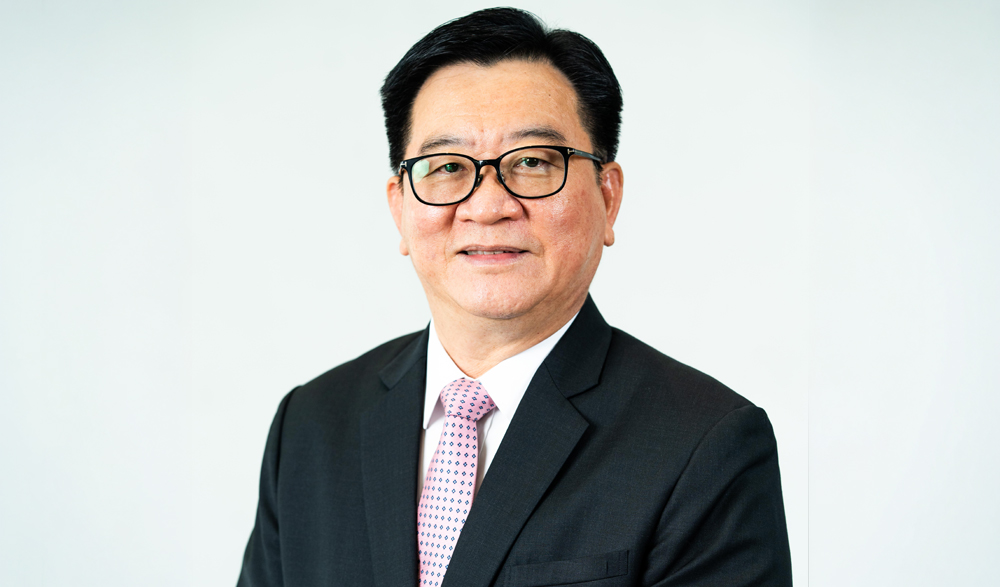
Jun 2026 Interview with Ti Eng Hui, CEO Baiduri Bank, Brunei
Brunei Darussalam stands out as one of the world’s most advanced Islamic finance jurisdictions, ranked 13th out of 140 countries in the Islamic Finance Development Report 2025. What structural reforms and market strengths have enabled Brunei to build one of the region’s most competitive financial services sectors over the past decade?
Brunei has always encouraged a dual-track banking system, with the conventional system on the one hand and the Islamic banking system on the other hand. As Brunei is an Islamic country, it obviously has a lot of strength on Islamic finance. However we give customers a choice to decide which one best fits their needs and that is something very positive.
Brunei’s banking system is very liquid because our currency is linked to the Singapore Dollar one-to-one. For this reason, there is a lot of flow between the two countries in terms of the payments and funds, which helps both Brunei and Singapore. As our banking system is liquid, many of the surpluses or balances that are not used in Brunei are parked in Singapore. Banks invest a lot in Singapore. Banks and central banks buy government treasury bonds because it is a very convenient way for Brunei banks to invest on their liquidity as they have surpluses.
Brunei does not impose capital controls, so funds can move in and out with ease. This is something foreign direct investors value and it is complemented by the strong stability we enjoy — our currency, our political environment and stable government. These factors make Brunei an attractive place to invest.
How is the financial services industry supporting Wawasan 2035’s diversification agenda, particularly in mobilizing capital for local industrialization and private sector expansion?
Brunei banks have been heavily involved in financing our diversification projects in the country. Primarily, Brunei has been an oil and gas country and financing has always been focused on that sector. We are seeing many changes now. Banks usually want to diversify the risk away from having too much concentration in one particular business sector. The diversification of the country into other areas of the economy allows banks in Brunei to diversify away from the oil and gas sector. That is good news for us. These projects are actually strategic for the country. We are on the ground and have a lot of liquidity.
Baiduri Bank was founded in 1994 and has evolved into one of Brunei’s leading financial institutions. How would you summarize Baiduri Bank’s journey since 1994 and its current strategic role within Brunei’s expanding financial ecosystem?
Baiduri Bank is the second largest bank in Brunei and the largest conventional bank. We do take part in the Islamic structures and work together with the Islamic banks in Brunei. The bank was established in 1994 as a purely corporate bank. I joined in 1996 to start the retail banking business when the board decided to diversify retail business or consumer banking business. We also set up a subsidiary firm called Brunei Finance to go into motor vehicle financing. The bank probably did not start at the best time, since the Southeast Asian financial crisis hit three years later, in 1997. Nonetheless, thanks to our strong balance sheet, the strong support received from the government and our customers, we managed to overcome that situation.
During our first ten years, we experienced growing pain. Growth only came during the second decade. Retail banking allowed us to collect more funding, often at lower cost. We could grow our corporate books, our retail books and our consumer finance books. This led to the acquisition of UOB, a Singapore bank retail business, and later on to the acquisition of HSBC corporate and retail portfolio when they exited the Brunei market. By the end of 2019, when I became the CEO, we became the largest bank. My task was to bring the bank to the next level.
Unfortunately, COVID-19 hit in 2020. It was a challenging time, as we had to move into a new head office in 2020 during the COVID-19 time. The bank’s performance took off in a rapid manner over the last three years. After COVID-19, when the borders opened, I took the team to Singapore to look at what banks in Singapore are doing as we have a lot of liquidity. In the past, we put our money in Singaporean banks and thought this was the best way to utilize our money better. Consequently, we had record profit over the last three years. We started enlarging our businesses. We created new business lines such as institutional banking. We expanded our corporate banking to include trade financing and supply chain financing and our retail business to focus more on wealth management. We created new centers to encourage financial planning. We also have a Financial Wellness Center. We strengthened our engagement with the MSMEs through our Enterprise Hub. With the strong commitment of our team, we were able to grow our business.
Pre-2019, our net profit level was below $40 million. Over the last three years, we have been able to achieve $70 million and above. In 2025, our profit hit $75.3 million. We have almost doubled our profit level. We have not only progressed on the financial results but also invested heavily on people and technology.
Baiduri Bank has always been known as an innovative bank. We were the first bank to launch a Visa debit card and mobile (SMS) banking in the country. We were also the first bank to launch internet banking. To make card acceptance more accessible to the MSMEs, we have launched Tap2Pay, which enables small businesses to accept card payments using smartphones. Technology and innovation are our key strengths. About half of our management committee members have a technology background or experience. That is not something common in many banks. We are comfortable to handle, manage and leverage on them to grow our business.
Baiduri Bank’s growth strategy very much revolves around supporting financial inclusion and SME development. Can you introduce the Financial Wellness Center and explain how it strengthens financial literacy and inclusion across Brunei?
Banks have always taken part in financial literacy roadshows organized by the Central Bank, the BDCB. To further complement their efforts, we decided to build the Financial Wellness Centre in the Baiduri Bank head office. It is a place where any interested party could come in and speak to our financial advisor. They could also experience all the financial interactive tools available in terms of the entire financial planning process, the outcome and the risk profile of that individual. We created that permanent space. We are the first and only bank to have created that kind of space. We have made these tools available online. It is a big commitment from the bank to promote more and more financial planning in this country.
We started this project as part of our CSR engagement. It was never a commercial venture but rather a CSR initiative in collaboration with Darussalam Enterprise. They run a number of workshops and training for the MSMEs in the country. We decided to work with them to organize these training activities and opportunities for these MSMEs in a more casual setting. Our enterprise hub is more like a co-working space. In fact, we offer co-working space facilities to these entrepreneurs to come in at any time by just signing up as a member. They can use the facilities and talk to like-minded individuals and entrepreneurs. The idea is to encourage engagement and sharing beyond the classroom. I think that created strong interactions between the bank and these MSMEs. I also think it created collaborations amongst the MSMEs. We are very proud of that project.
What concrete actions has Baiduri Bank taken to reduce its own carbon footprint while expanding green financing options for clients?
While frameworks and blueprints are helpful guides, we want to go beyond that. Our aim is to help the country transition to a greener economy and greener energy. At this stage of our national energy transition, solar remains the primary focus, while other clean energy solutions continue to be actively explored. We are very proud to share that as of today, we are the only bank that has financed two solar projects in Brunei. We work very hard to secure this financing. We are pleased to say that we were able to provide full financing for two major solar projects in Brunei. I think those are very good achievements. We plan to do more.
Green finance in Brunei is still evolving, but the introduction of mandatory carbon reporting marks an important foundation for progress. As broader sustainability policies continue to take shape, they will be key in guiding how businesses transition over time. In line with national priorities and development plans, Baiduri Bank is moving in tandem with this direction, positioning ourselves to support our clients and capture emerging opportunities in sustainable finance.
Under the Brunei Digital Economy Master Plan 2025, the financial sector has undergone rapid digital transformation. What digital milestones best define Baiduri Bank’s transformation journey, and how has this positioned the bank as a leader in Brunei’s digital banking?
We cover the retail business, corporate business and treasury business, all highly dependent on technology. We need to invest more in this area. I am very fortunate to have the board support to invest in technology. We worked closely with regulators throughout the process, particularly as the industry’s approach to Cloud computing evolved post-COVID-19.
We also had very early engagement with regulators along the process. I think they understood what we were trying to do. Cloud banking gives us access to robust, expertly managed technology platforms, enhancing operational resilience and allowing greater agility. Systems in the cloud can be scaled as business grows. The idea of scalability and taking advantage of the latest features and latest upgrades on a yearly basis appeal to us. Those upgrades and new features are not something that can easily be done on-site. The cloud-based system gives us a lot of flexibility. That is number one in addressing the technology needs of the bank.
Secondly, it addresses the shortage of IT personnel that we have in the country. Thirdly, it addresses the scalability of what we need in the future. As a result, we are now able to look at other solutions that can integrate with our cloud solutions. In the past, integration was always a pain. Moving forward, we are looking at integrating our cloud-based call banking with other systems making the process easier and faster. This is only the start of a journey with more to come from the bank.
Looking ahead, which disruptive technologies are likely to reshape banking in Brunei and how is Baiduri Bank preparing to remain at the forefront of this shift?
Every industry, including banking, talks about AI. AI has been increasingly used in many industries. The finance sector is no exception. AI is applied to many applications. We expect the disruption to be ongoing and continue to change things. I think the challenge is to manage the ongoing changes. We are dealing with disruption every week and every month. The challenge is about managing that constant change and making sure the staff can deal with the pressure because of constant change. I think the pressure is not only on AI but also on the people. Banks are really working hard on this situation.
In 2025, Baiduri Bank expanded its regional presence with the opening of a representative office in Singapore. How does the launch of the Singapore office enhance Baiduri Bank’s regional connectivity and elevate Brunei’s financial profile internationally?
Singapore is a financial center and a global hub. We decided to be there. We already invested a lot in Singapore. I think having a physical presence on the ground increased our visibility, our branding and our awareness. There is potential for us in Singapore. The opening of the office is only a starting point. Eventually, we would like to convert that into a branch and grow our businesses from there. As a hub, the deals are not just Singapore deals, but also from other Association of South East Asian Nations (ASEAN). We see Singapore as a place where the ASEAN countries are looking at funding, financing and at wealth management. It is an ideal and convenient market not too far away from Brunei. It has the same currency parity as Brunei. The question is what is next after Singapore?
For US and other foreign investors, what strengths position Brunei as a credible and attractive financial gateway in Southeast Asia and why is this a timely moment to engage?
Brunei banks are connected to the financial system worldwide. We are a member of SWIFT, which means that we can arrange payments throughout the world. We can also issue letters of credit, trade financing and import financing. As part of the global banking system, we can reach out to banks anywhere in the world. We also work actively with more than 70 counterparty banks globally. We are really a part of a global network.
Brunei has a reach similar to Singapore. As mentioned earlier, the stable political situation in the country, the strong currency, low capital control and the location are all unique. I believe when you combine all the factors together, it is really a good place for investment. Brunei has relatively low customs duty compared to other countries.
How would you summarize your vision and ambitions for the bank and what legacy do you hope to leave in shaping Brunei’s modern financial landscape?
We are already the second largest bank in Brunei. The growth will come from Brunei and outside Brunei. Baiduri is a very successful Brunei brand. I am proud of it and honored to be part of this growth story. We were able to build an institution from scratch. It was a small corporate bank of 40 staff when I joined in 1996. Now we are a large comprehensive bank with about 1,000 staff. With the dedication of local Bruneian staff, we can say that it is a successful Brunei story. It is a legacy for the next generation to take it to new heights.
What’s your final message for the readers of Foreign Policy?
Come to Brunei, meet the people and talk to the various businesses in different sectors. Moreover, take the time to talk to bankers and government officials. In Brunei, many of us are reachable. We are happy to share the stories. We can create the bridge for many of our successful FDIs to meet future investors. We have seen many success stories for companies from Japan, Korea, Canada, Singapore and Malaysia, for example. Shell has a long-time presence here too. Come to Brunei and talk to people. It is the best way to learn more about the country.
Sorry, the comment form is closed at this time.